It’s easy to feel like the world has lost its mind.
Everywhere we look—on TV, online, in headlines and comment sections—we’re met with suffering, violence, fear, outrage, and division. Many people feel as though what we’re witnessing today is unprecedented, as if the world has suddenly tipped into a level of chaos never seen before.
The truth is, it hasn’t.
There have always been wars. There has always been poverty, illness, injustice, cruelty, and loss (to a much greater degree than today). What is new is the constant exposure to it all. Never before have human nervous systems been asked to process the pain of the entire planet in real time, all day long. The volume is relentless, and without realizing it, many of us become swept away by it.
That’s when overwhelm sets in.
There’s a quote from Rumi that I love, it captures this idea beautifully: “Yesterday I was clever, so I wanted to change the world. Today I am wise, so I am changing myself.” This isn’t about giving up on the world (far from it). It’s about understanding where real, sustainable change actually begins.
Inside First, Then Outside
Many spiritual traditions point to a simple but challenging truth: inner peace radiates outward. Cultivating personal harmony, love, and clarity creates positive ripples in your external environment and relationships, fostering a more peaceful world one individual at a time. This is one of the best ways for any individual to have a huge impact on the whole of humanity. We cannot offer clarity, compassion, or healing from a place of inner chaos. If we are dysregulated, fearful, or chronically overwhelmed, our attempts to help often become reactive, exhausting, or fueled by urgency rather than wisdom.
Before we can engage the world in a way that is truly helpful, we need to be steady inside. Grounded. Resourced. Able to remain present without collapsing under the weight of everything that feels “wrong”. This is where the idea of radical acceptance becomes essential.
What Radical Acceptance Really Means
Radical acceptance does not mean approving of suffering. It does not mean becoming passive, indifferent, or numb, and it certainly does not mean giving up on change. Radical acceptance means acknowledging reality as it is before trying to change it. The truth is, everything is ok—everything is unfolding for humanity perfectly.
Many spiritual teachers speak of the universe as an unfolding governed by cause and effect—everything arising in relationship to everything else. From this wider perspective, nothing is accidental. Even the moments we most wish weren’t happening belong to the whole. Everything that has ever happened or will happen is just how it should be.
This truth can be deeply uncomfortable to sit with.
Because while suffering may fit into a larger pattern, it still hurts. It still presses against the human heart. If we cannot accept that suffering exists as part of what is unfolding, we end up fighting reality itself—burning enormous amounts of energy resisting what already is. Until we can accept the perfection within the suffering, we will struggle.
Acceptance doesn’t erase pain, but it does soften the inner war. It allows us to respond rather than react. To stay present rather than overwhelmed. To act from clarity instead of panic.
A Gentle Inner Check-In
Before rushing to fix, react, or intervene, it can be helpful to pause—not to judge ourselves, but to notice where we’re actually coming from. Am I in a good place to do something about “X”? (whatever the issue may be)
You might ask yourself:
-
Am I regulated right now, or am I emotionally overwhelmed?
-
Do I feel grounded in my body, or am I operating from tension and urgency?
-
Am I resourced enough—physically, emotionally, and energetically—to show up without resentment?
-
Am I helping because I feel genuinely called, or because I feel guilty, anxious, angry or afraid?
-
Am I trying to fix something outside of me to avoid what’s happening inside me?
-
Can I continue this without burning out? Does this action feel nourishing, neutral, or depleting?
-
Am I responding consciously, or reacting emotionally?
-
Can I acknowledge the suffering without letting it consume me?
-
Can I accept that I cannot fix everything?
This isn’t a test, and there are no wrong answers. It’s simply a way to notice whether we’re acting from balance or from overwhelm. What we bring into the world carries energy with it, and that energy matters. When we react rather than respond, we can unintentionally amplify the very fear or negativity we’re hoping to transform.
If You Realize You’re Not in a Balanced Place
If your honest answer is that you’re not resourced enough right now, that’s not a failure—it’s wisdom.
Sometimes the most compassionate action is to pause.
That pause might look like stepping back from constant news or social media consumption, resting your nervous system, reconnecting with your body, or returning to simple moments of beauty and joy. It might mean allowing yourself to be supported instead of always supporting others.
Tending to your inner world is not separate from helping the outer one. It is part of it.
When we are grounded inside, our presence itself becomes stabilizing. Our compassion becomes sustainable. Our actions become clearer and less driven by urgency or fear.
Meeting the World as It Is
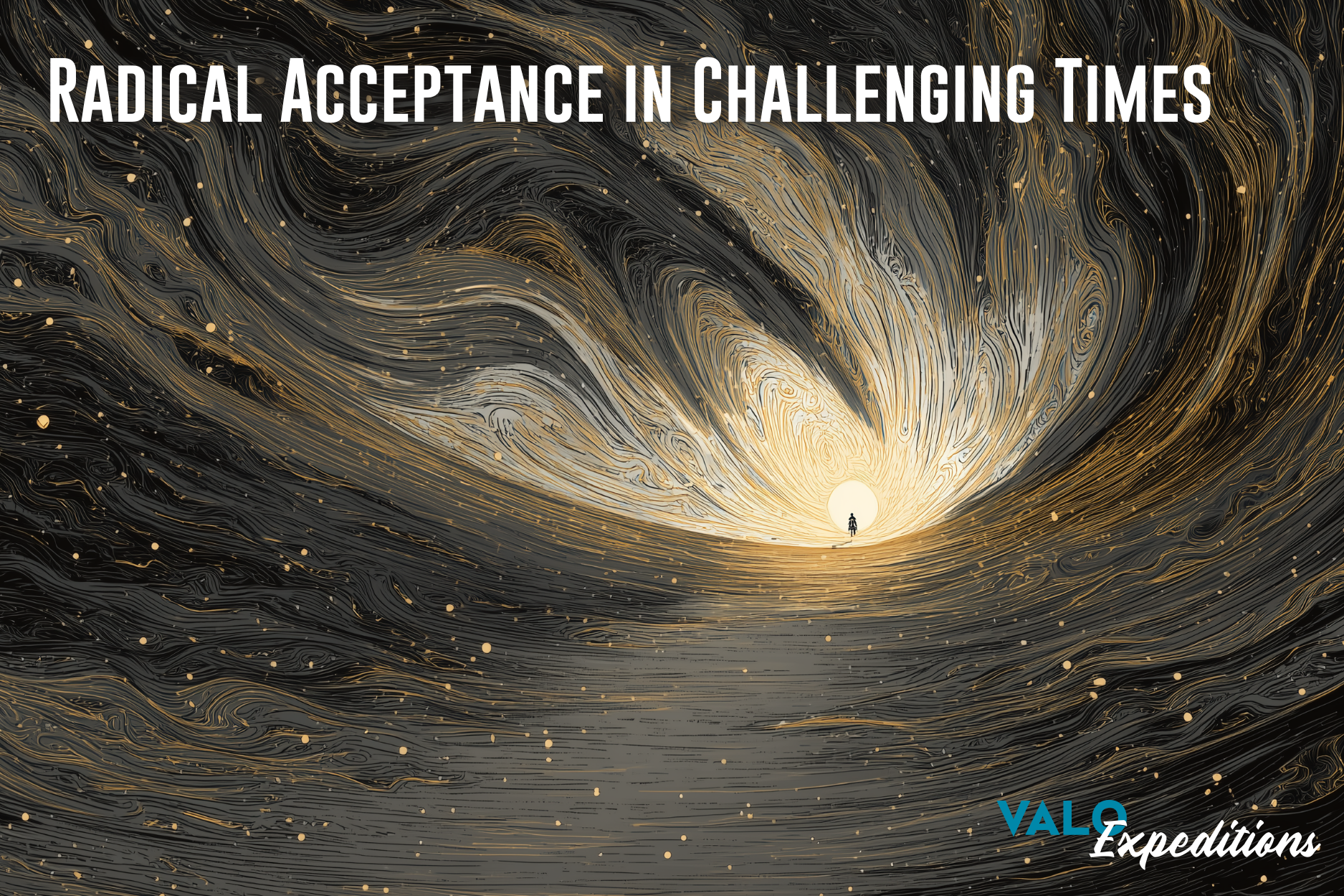
Radical acceptance doesn’t ask us to love everything that happens. It asks us to stop arguing with reality long enough to meet it honestly.
Perception matters. How we relate to what’s happening matters. We can want the world to change and still recognize that, on a deeper level, nothing is out of place. Even in dark times, there is a larger order unfolding. That is how we stay grounded instead of overwhelmed, and how we keep our hearts open without being pulled under.
Since embracing radical acceptance, the world has become much easier to navigate. I no longer experience life as constant chaos, but as something unfolding—sometimes gently, sometimes painfully, but always meaningfully, always perfectly. That shift has changed how I interpret what is going on around me and how I move through even the most challenging moments.
Accepting that everything is unfolding exactly as it should has brought an unexpected sense of peace. I still care deeply and I still feel compassion, I will take action when it is my highest passion—but I’m no longer at war with what is. From this place, it becomes possible to meet the world with steadiness and groundedness rather than overwhelm, with openness and fascination rather than fear. In doing so, we find that we don’t need to carry the weight of everything to remain deeply, lovingly engaged with life.