Science, Symbolism, and Insight
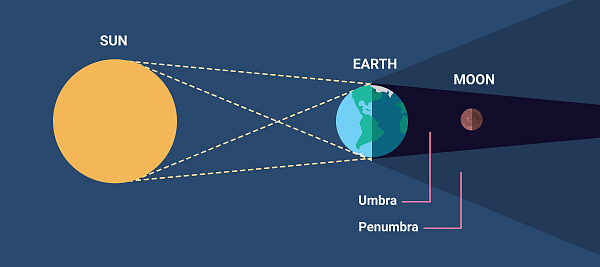
In the early morning hours of March 3, we will experience a total lunar eclipse — the only one in 2026 and the last we’ll see for several years. For those of us in the Pacific Northwest, this will unfold across the middle of the night, with the Moon slipping into Earth’s shadow and turning a deep, reddish copper during totality. A total lunar eclipse occurs when the Sun, Earth, and Moon line up perfectly, and the Moon passes through the darkest part of Earth’s shadow, the umbra. As this happens, sunlight bends through Earth’s atmosphere and scatters, leaving only the warmer red and orange wavelengths to wash across the lunar surface. It’s one of nature’s clearest demonstrations of cosmic alignment.
Pacific Time Viewing Schedule (PNW)
All times below are Pacific Standard Time (PST):
- Penumbral Eclipse Begins (Subtle dimming): 12:44 a.m. PST
- Partial Eclipse Begins (Bite taken out of moon): 1:50 a.m. PST
- Totality Begins (Red Moon): 3:04 a.m. PST
- Maximum Eclipse: 3:33 a.m. PST
- Totality Ends: 4:02 a.m. PST
Totality lasts for about 48 minutes, and the eclipse as a whole stretches over 5½ hours. Lunar eclipses are safe to watch with the naked eye — no special glasses required. Binoculars or a telescope simply enhance the experience. This is also a uniquely important eclipse because the next chance to see a total lunar eclipse without traveling won’t come again until late 2028.
Across ancient civilizations, lunar eclipses were viewed as extraordinary and meaningful. In Mesopotamia, they were connected to leadership and fate. In China, a darkened Moon symbolized cosmic imbalance, prompting rituals to restore harmony. Maya and Aztec skywatchers used eclipses as markers within their intricate calendars, seeing them as portals between cycles. Indigenous cultures worldwide treated eclipses as times for reflection, storytelling, and connecting with ancestral wisdom. No matter the culture, eclipses symbolized thresholds — moments between one cycle and the next.
Symbolically, a total lunar eclipse amplifies themes of release, completion, awareness, and transformation. The Moon represents our inner world: intuition, emotion, memory, and the subtle wisdom held beneath the surface of everyday consciousness. When Earth’s shadow covers the Moon, there is a natural pull toward introspection. Many people feel this as a moment of emotional clarity — a chance to let go of outdated patterns or beliefs and make room for what feels more aligned with who they are becoming. Eclipses mark transitions already taking shape, bringing them into awareness so we can move forward with intention.
For those on a path of consciousness exploration, this eclipse is a perfect opportunity to tune into your inner rhythm. Notice what feels like it’s ending or evolving. Notice what is trying to rise within you. If you’ve been moving through shifts or awakening moments, the energy of this eclipse supports integration. It bridges the space between what you’re releasing and what you’re stepping into.
Here in the Pacific Northwest, weather often adds its own twist. Clouds, fog, and rain are very possible — and none of that prevents you from connecting with the eclipse. Even if the sky is completely covered, you can still step outside at the time of totality (between 3:04–4:02 AM PST) and stand beneath the part of the sky where the Moon is passing through Earth’s shadow. Whether you can see it or not, you’re still in the alignment. The energy is present, the timing is the same, and you’re participating in the moment.