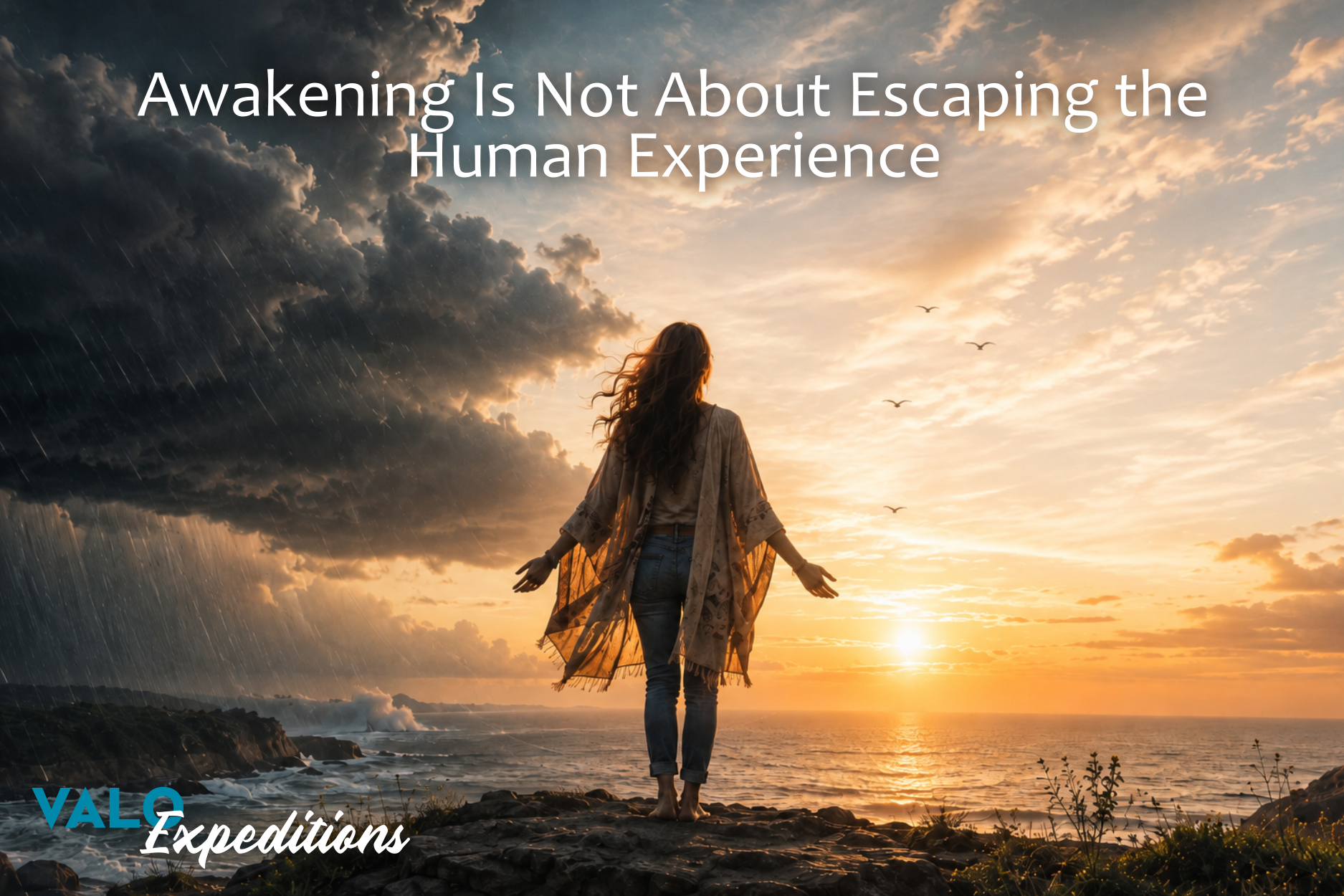
When people talk about expanding consciousness or awakening, the conversation often leans toward transcendence. We hear about rising above fear, letting go of anger, moving beyond the ego, and becoming more peaceful, loving, and aware. There is value in all of that. Greater awareness can absolutely change the way we relate to ourselves and the world around us. Yet sometimes the idea of spiritual growth can quietly become something it was never meant to be: a way to escape the human experience.
We may begin to believe that if we are truly conscious, awakened, evolved, or spiritually connected, we should no longer feel certain things. We should not get angry. We should not feel jealous. We should not become frustrated, afraid, heartbroken, impatient, uncertain, or overwhelmed. Somehow, we imagine that spiritual growth should allow us to float above all of it. Except that we are here, in human bodies, having human experiences. Maybe consciousness expansion is not about becoming less human at all. Maybe it is about becoming more fully human.
Human life is full of contrast. We experience love and loss, joy and grief, confidence and uncertainty, connection and loneliness, excitement and disappointment, desire and fulfillment, fear and courage. It is easy to label one side of those experiences as good and the other as something we need to overcome, but what if all of it has something to offer us? Grief exists because we have loved. Anger can show us where a boundary has been crossed. Jealousy may reveal an insecurity, longing, or desire we have not fully acknowledged. Fear can point toward the places where we feel vulnerable. Even discomfort can become information.
None of this means we need to live inside difficult emotions indefinitely or allow them to control our lives. It simply means that immediately trying to eliminate them may cause us to miss what they are showing us. Sometimes the expansion comes from staying curious long enough to ask why we are feeling what we are feeling.
One of the biggest changes that can happen as we become more conscious is not necessarily that difficult emotions disappear. It is that we begin to notice them differently. There is a subtle shift between experiencing anger and recognizing, “I am angry right now.” There is a difference between being consumed by fear and realizing, “Fear is moving through me.” That small amount of awareness creates space.
We may still feel the emotion just as strongly, but we are no longer completely identified with it. We can observe what is happening within us while we are experiencing it. Over time, we may begin to notice the beliefs, patterns, memories, expectations, and triggers underneath our reactions. We might recognize that something happening in the present is touching an old wound. We may discover that a belief we have carried for decades did not actually originate with us. The experience becomes an opportunity to understand ourselves more deeply. Expansion does not always mean feeling better. Sometimes it means seeing more.
There is a great deal of beautiful wisdom within spiritual teachings about love, gratitude, forgiveness, acceptance, and peace. Problems can arise when those ideas become expectations. If we begin to believe that anger lowers our vibration, sadness means we are out of alignment, or fear will somehow attract more negative experiences into our lives, we may start suppressing perfectly natural emotions.
We might smile when we want to cry. We might forgive before we are ready. We might tell ourselves that everything happens for a reason when what we really need is permission to admit that something hurt. Spiritual concepts can become another way of avoiding ourselves. This is sometimes called spiritual bypassing, when spiritual beliefs or practices are used to move around uncomfortable emotions rather than through them.
The intention may be positive, but avoiding an emotion does not necessarily resolve it. Sometimes the most conscious thing we can do is simply admit, “This hurts.” Or, “I am angry.” Or even, “I have no idea what happens next.” There is tremendous honesty in allowing ourselves to be where we actually are.
I sometimes think of consciousness expansion less as rising upward and more as expanding outward. Our capacity grows. We become capable of holding more complexity. We can love someone and still be frustrated with them. We can be grateful for our lives while also wanting something to change. We can trust our path while still experiencing uncertainty. We can believe that an experience helped us grow while also acknowledging that we would never choose to experience it again. Two seemingly contradictory things can be true at the same time.
As our awareness expands, perhaps we become less interested in categorizing every experience as positive or negative and more interested in understanding what it is showing us. We become curious participants in our own lives rather than constantly judging whether we are doing spirituality correctly.
If consciousness wanted only stillness, peace, and unity, perhaps there would be no need for physical life at all. Yet here we are. We have bodies that get tired. We form relationships that change us. We fall in love. We lose people. We make mistakes. We laugh until we cry. We experience heartbreak, excitement, boredom, pleasure, longing, curiosity, fear, awe, and moments of indescribable connection.
We are able to touch, taste, hear, smell, create, explore, and experience reality from one very particular point of view. There is something extraordinary about that. The human experience is not something consciousness needs to escape, it is one of the ways consciousness learns about itself.
Every relationship, emotion, challenge, joy, and surprise gives us another perspective through which to experience existence. That does not mean every painful experience needs to be romanticized or turned into a lesson. Some things simply hurt. We can still grow from them without pretending we are grateful they happened.
Maybe enlightenment is not the absence of difficult human experiences. Maybe it is the ability to remain conscious while we are having them. It is noticing ourselves, questioning our automatic reactions, feeling what we feel without immediately judging it, and recognizing when we are projecting, avoiding, clinging, or repeating an old pattern. It is apologizing when we get something wrong, laughing at ourselves, changing our minds, and recognizing that we are always learning.
Consciousness expansion may not make us perfectly peaceful people who never become triggered, frustrated, or confused. It may simply make us more aware of what is happening within us when we do. That awareness gives us choices we may not have had before.
There can be a strange pressure within personal growth and spirituality to constantly become a better version of ourselves. There is nothing wrong with wanting to grow, but I wonder if we sometimes forget to actually live while we are busy trying to evolve. Maybe we are not here to become flawless. Maybe consciousness does not need perfection. Maybe it needs experience.
The beautiful parts, the uncomfortable parts, the strange parts, and the messy parts all become part of the story we are living. The moments that make complete sense and the moments that leave us questioning everything are all part of being here. Awakening does not mean escaping the human experience. It means entering it more deeply, paying attention, remaining curious, feeling fully, and learning continuously.